The Complete Turmeric Buying Guide: Shots, Capsules, Extracts and Whole-Root Powder
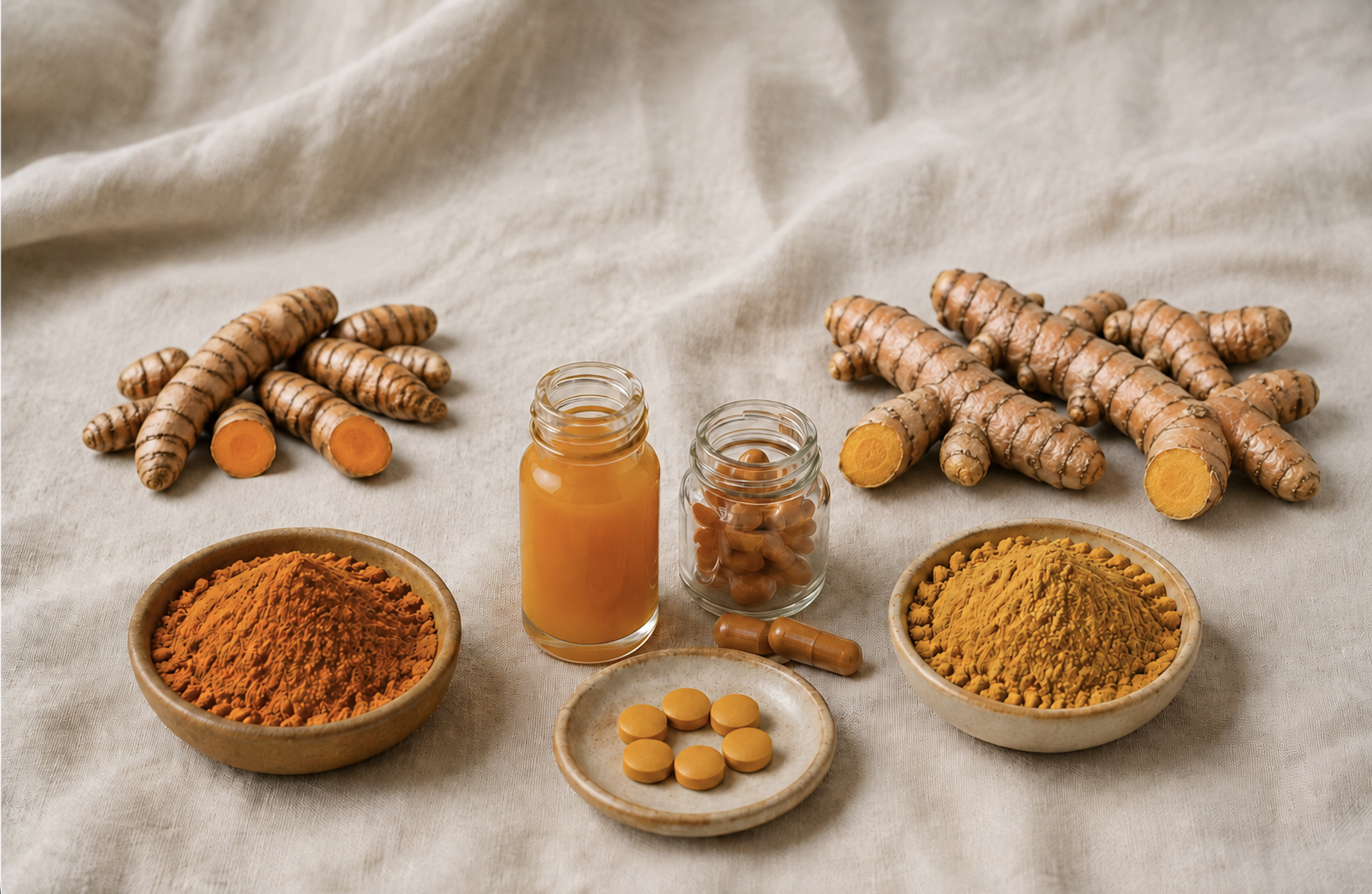
The many faces of turmeric and curcumin
Buying turmeric can feel like navigating a jungle. Here is how to see through the numbers, understand what you are paying for and choose a turmeric you will genuinely enjoy taking every day.
Buying turmeric should be simple.
Instead, one product advertises grams of fresh root. Another promotes milligrams of curcuminoids. A third contains a concentrated extract. A fourth simply says "turmeric" without identifying the variety, origin or natural potency.
They all use the same familiar word.
But they are not selling the same thing.
I know how confusing it is because I have gone down the rabbit holes myself—which I love to do… reading studies, checking calculations, contacting companies and asking questions most customers would never realise they needed to ask.
One particular claim compelled me to investigate further:
"Up to 1,750 mg of curcumin."
It appeared on the website of a well-known turmeric-shot company.
It sounded extraordinary. But once I followed the calculation, I discovered and confirmed with the company that the figure was based on a fresh-root weight whereas a curcumin percentage is conventionally expressed on a dry-weight basis. So their claim is at best misleading.
That was when I realised customers needed a genuine turmeric buying guide.
Not another list of supposed benefits.
Not another brand shouting the biggest number.
A practical guide showing you what those numbers actually mean, what may be missing and how to identify turmeric that is potent, traceable, whole and worth taking consistently.
The seven things that determine what you are really buying
Before choosing a turmeric product, ask:
Is it fresh turmeric or dried turmeric?
Has the curcumin content actually been tested—or merely assumed?
What happens to the root during pressing or extraction?
Does it contain whole turmeric or a concentrated extract?
Which turmeric variety and origin are you buying?
How much real turmeric is in the finished product?
Will you genuinely enjoy taking it consistently?
These seven questions tell you far more than an enormous number on the front of a bottle.
1. Is it fresh turmeric or dried turmeric?
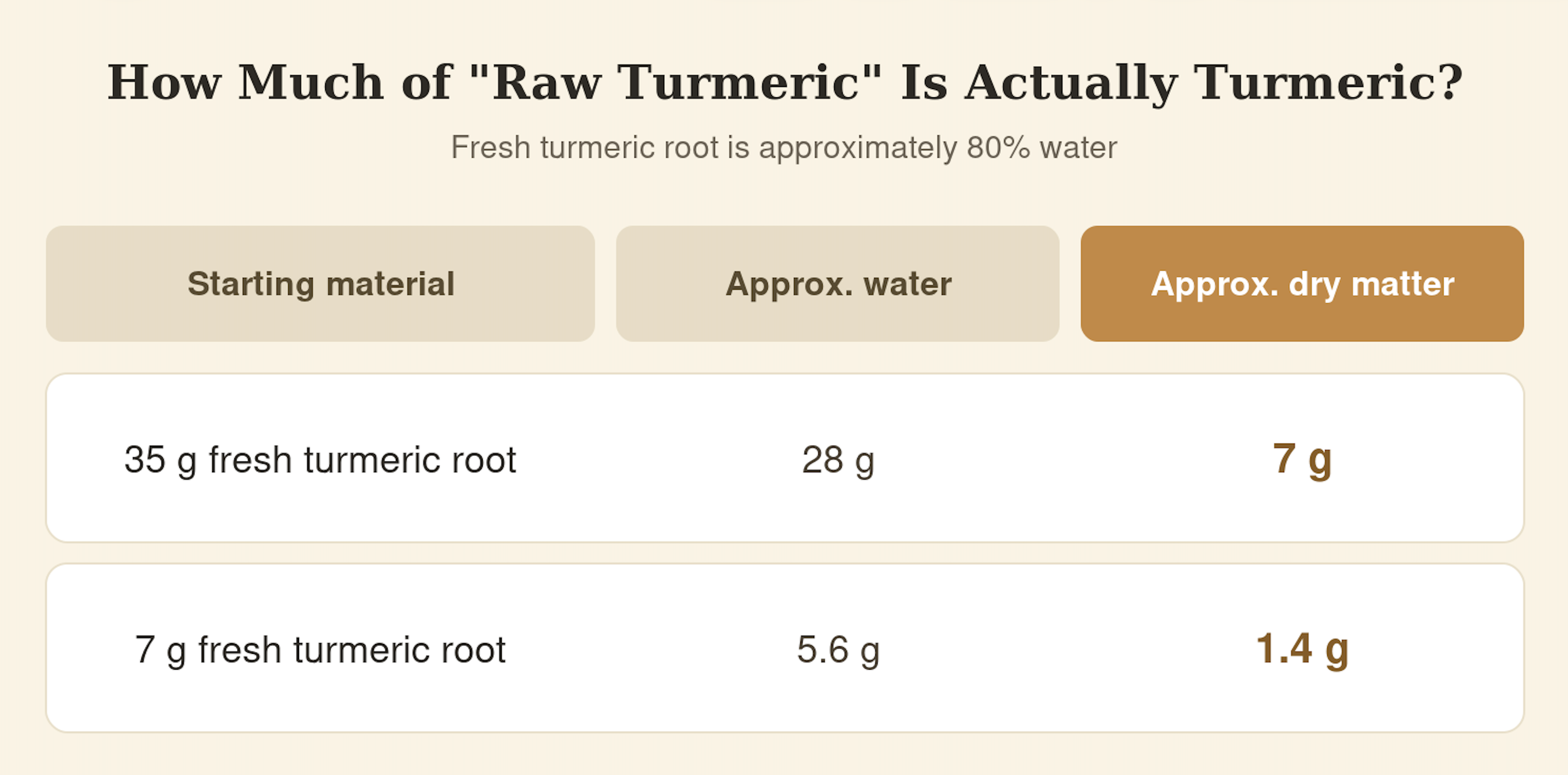
How much of turmeric shots are actually turmeric?
This is the first distinction—and one of the most important.
Fresh turmeric commonly contains around 80% moisture, although natural variation occurs. Dried turmeric has had most of that water removed.
That means:
35 g of fresh turmeric is not equivalent to 35 g of dried turmeric.
Approximately 35 g of fresh turmeric may contain only around:
28 g of water; and
7 g of dried turmeric matter.
This matters because curcumin percentages are conventionally measured against the dried turmeric, not against the water inside a fresh root.
Yet fresh-root weight can look far more impressive on a label.
The 1,750 mg claim that made me look twice
The turmeric-shot company said its product used 35 g of fresh turmeric containing "up to 5% curcumin".
The apparent calculation was:
35 g × 5% = 1.75 g, or 1,750 mg
The arithmetic looks correct.
The measurements are not.
If approximately 80% of the fresh root is water, only around 7 g is dried turmeric matter.
Applying the stated maximum of 5% to that dried matter gives:
7 g × 5% = 350 mg of curcumin before pressing
For 35 g of fresh root to contain 1,750 mg of curcumin, the fresh root would need to be 5% curcumin including all its water.
At approximately 80% moisture, that would be equivalent to around 25% curcumin in the dried turmeric. Which simply does not exist in reality. Anywhere!
But the company's own assumption was only "up to 5%".
The 1,750 mg figure therefore cannot be produced when that 5% is applied on the conventional dry-weight basis.
2. Has the curcumin content been measured—or merely assumed?
The words "up to" matter.
"Up to 5% curcumin" does not mean the turmeric used in that production batch contained 5%.
It could have contained 4%, 3% or less.
Using 35 g of fresh turmeric at approximately 80% moisture:
At 5%, the whole root theoretically contains about 350 mg before pressing.
At 3%, it contains about 210 mg before pressing.
At 2%, it contains about 140 mg before pressing.
So even the corrected 350 mg is a theoretical maximum based on the highest assumed percentage—not necessarily the composition of the root that entered the bottle.
I contacted the company and asked whether the finished shot had been independently tested and shown to contain 1,750 mg of curcumin.
It confirmed in writing that it had not.
The figure had been calculated from the assumed highest potential curcumin content of the raw root before processing. (prior to removing water and curcumin rich pulp)
The company said its turmeric had been genetically tested to confirm its variety. That may help establish botanical identity, but it does not quantify the curcumin content of a particular harvest.
DNA and chemical analysis answer different questions:
Genetic testing helps identify what the plant is.
Chemical analysis establishes which compounds are present and in what quantities.
Research comparing DNA barcoding with HPLC chemical fingerprinting has found only a weak relationship between genetic and chemical variation. Knowing a turmeric's genetic identity does not tell you its precise curcumin percentage.
To establish curcumin content, the batch needs appropriate chemical analysis. To establish how much reaches a bottled shot after production, the finished drink itself needs to be tested.
This is why you should be cautious when an "up to" percentage is converted into a precise milligram claim.
A maximum estimate is not a batch result.
And a raw-root calculation is not a finished-product assay.
A real agricultural trial supports the lower figure
Independent cultivation data backs up the moisture-adjusted estimate rather than the original claim. A multi-year turmeric cultivar trial conducted around Chintapalli, in the agency areas of north coastal Andhra Pradesh, recorded one line containing 5.4% curcumin that produced cured material equal to 19.5% of its fresh weight.
Applying those measured figures to 35 g of fresh root:
35 g × 19.5% cured recovery × 5.4% curcumin ≈ 369 mg curcumin
A figure of 1,750 mg would require a minimum 175 g of fresh turmeric root—not 35 g
3. What happens when fresh turmeric is pressed?
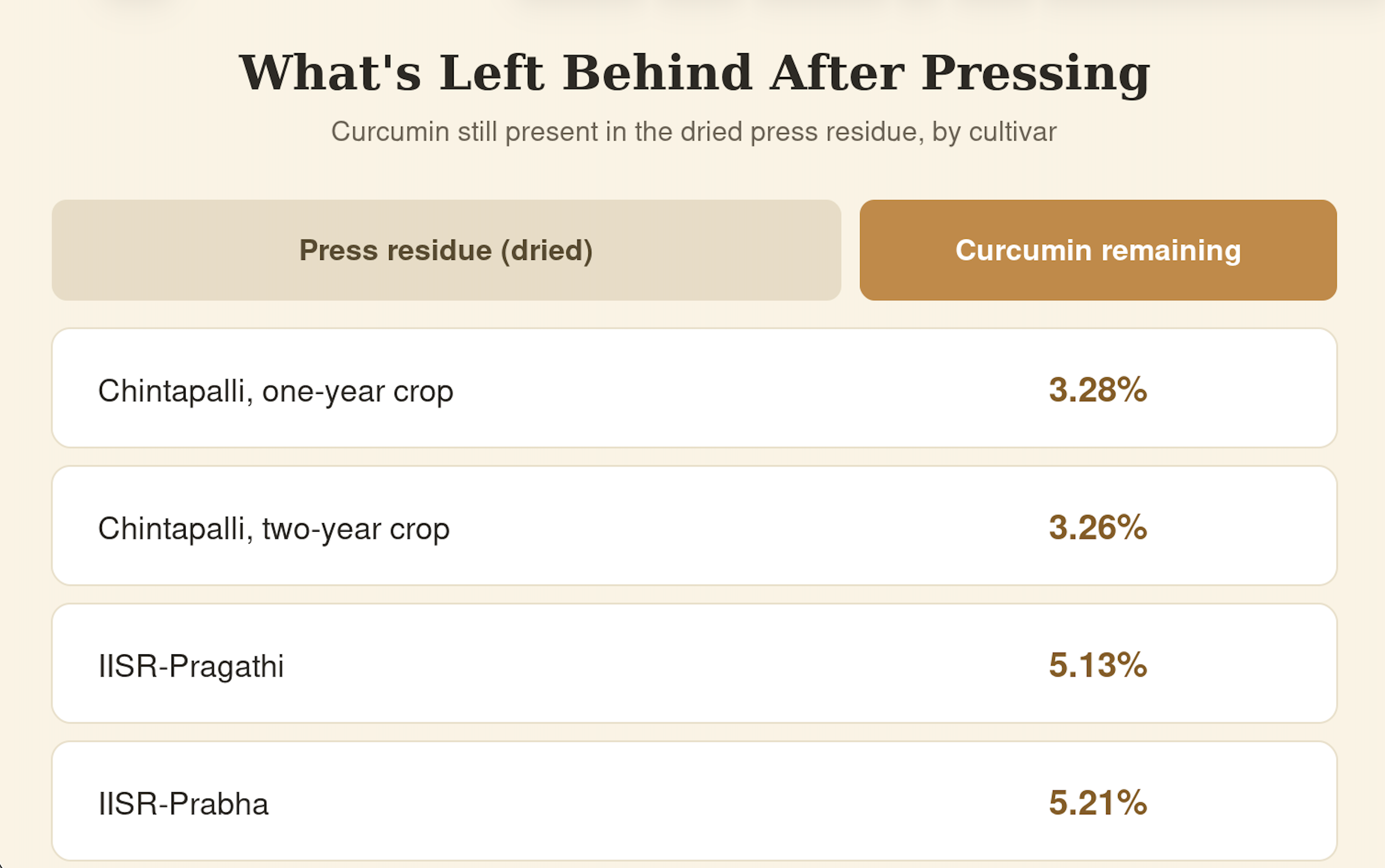
Curcumin residues in the pulp left behind from pressed juice shots.
Even a valid estimate for the whole fresh root does not tell us what remains in the finished shot.
Pressing separates turmeric into juice and fibrous residue.
A 2023 study from the ICAR–Indian Institute of Spices Research analysed the residue remaining after turmeric juice extraction.
Once dried, that residue still contained:
3.26–5.21% curcumin
9.66–15.53% oleoresin
5.06–6.30% essential oil
The remaining aromatic oil included naturally occurring turmerones.
The results will vary according to turmeric variety and production method, so this study cannot reveal the curcumin content of every commercial shot.
It establishes the principle that matters:
Fresh-root weight tells you what entered the press. It does not tell you what reached the bottle.
Only testing the finished drink can do that.
Does this mean turmeric shots are bad?
No.
A turmeric shot can be fresh, sharp, convenient and enjoyable.
The problem is not the format. The problem is trying to compare its fresh-root weight directly with dried whole turmeric—or treating a theoretical pre-processing estimate as though it were a measured quantity in the finished bottle.
Several UK shots I reviewed contained around 7 g of fresh turmeric, often without naming the variety.
Seven grams of fresh root at approximately 80% moisture contains around 1.4 g of dried turmeric matter.
If that turmeric contains 2.5% curcumin:
1.4 g × 2.5% = 35 mg before pressing
Much may then remain in the separated pulp.
This is only an illustrative calculation, not a measurement of any finished shot. But it demonstrates why grams of fresh root and grams of dried root cannot be compared directly.
Same plant. Different form. Different measurement.
4. Does the capsule contain whole turmeric or an extract?
Capsules create a different kind of confusion.
A capsule may contain dried whole-root powder or a concentrated curcuminoid extract. These are fundamentally different preparations.
For example:
A 500 mg whole-turmeric capsule at 2.5% provides approximately 12.5 mg of curcumin.
A 500 mg capsule containing 95% curcuminoids is a highly concentrated extract.
You also need to distinguish curcumin from curcuminoids.
Turmeric's principal curcuminoids include:
curcumin;
demethoxycurcumin; and
bisdemethoxycurcumin.
Therefore, "95% curcuminoids" does not automatically mean "95% curcumin". It describes a concentrated family of related compounds.
Traditional turmeric use, including within Ayurveda, centres principally on the whole rhizome and food-based preparations. Much modern clinical research has examined concentrated extracts at specified doses.
These are different preparations supported by different forms of evidence. Findings from one should not automatically be applied to another.
Concentrated is not necessarily the most appropriate choice for every person or every day. High-dose extracts may be unsuitable for some people and can interact with medicines.
Anyone taking medication—particularly anticoagulant or antiplatelet medication—or managing a health condition should seek individual professional advice before using a concentrated curcumin supplement.
5. Which turmeric are you actually buying?
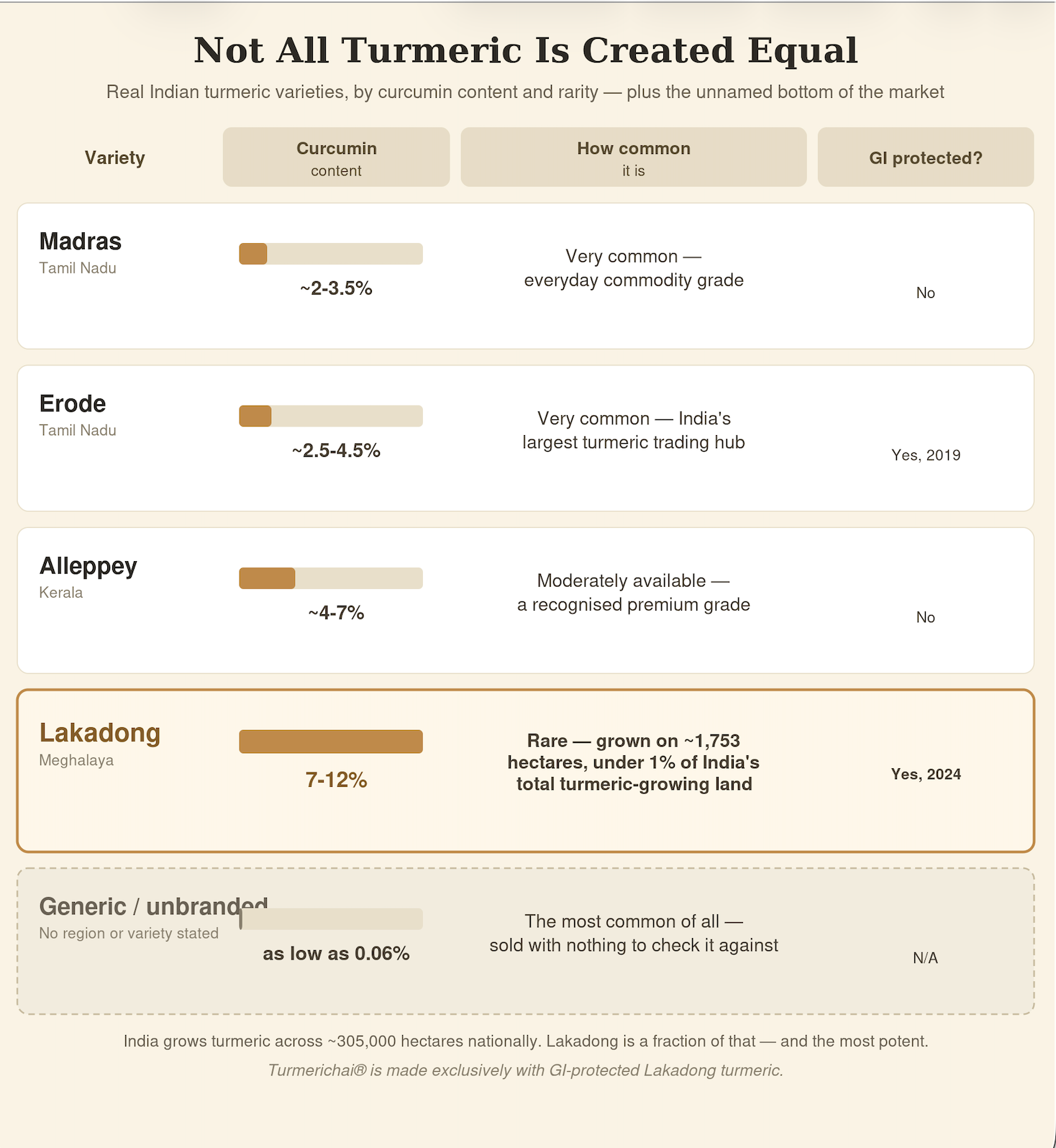
Even two whole-root turmeric powders can have very different natural potency.
Turmeric is not one chemically identical commodity.
Cultivar, soil, climate, harvest, processing and storage can all affect its curcumin and aromatic-oil content.
Yet many products simply say:
Turmeric
No named variety. No precise origin. No batch-tested potency.
The label may tell you the plant species, but not the quality of the turmeric inside.
Authentic Lakadong is rare—which is why I go to the farms
Lakadong turmeric is traditionally cultivated in the Jaintia Hills of Meghalaya and protected by a Geographical Indication, or GI tag.
The GI designation connects the Lakadong name to its recognised place of origin, distinctive characteristics and generations of local cultivation knowledge.
But a certificate alone is not enough for me.
Authentic Lakadong is rare and produced in limited quantities. Demand for the name extends far beyond the region where genuine Lakadong is cultivated.
That is why I travel to the Jaintia Hills, visit the farms and cultivate genuine, long-term relationships with the people growing it.
I want to know where our turmeric comes from. I want to see how it is cultivated. And I want the growers to know who is taking their turmeric into the world.
These relationships are not a marketing exercise.
They are how EMAYA protects quality, traceability and continuity—from the soil in Meghalaya to the turmeric in your cup.
The GI tag helps establish geographical identity. Chemical batch testing establishes the natural potency of the turmeric from a particular harvest.
The Lakadong turmeric sourced for EMAYA has tested between 8.5% and 12% curcumin before blending.
At 10%, one teaspoon of whole Lakadong naturally provides approximately the same curcumin as:
four teaspoons of whole turmeric at 2.5%; or
five teaspoons of whole turmeric at 2%.
This is not curcumin extracted and added to ordinary turmeric.
It is the natural potency of a rare, named and traceable whole root.
With generic turmeric, you may know the plant's name. With EMAYA's GI-tagged, batch-tested Lakadong, you know where it comes from, who grows it and what you are actually getting.
Curcumin matters—but it is not the whole root
The turmeric market has become so focused on curcumin that the rest of the plant is often treated as though it does not matter.
Lakadong also contains aromatic oils, including turmerones.
Research examining Lakadong grown across five regions found that ar-turmerone represented approximately 36–44% of its rhizome essential-oil fraction, This is being studied for its brain health benefits. Although the precise composition varied with the growing conditions most common turmeric only has 15% ar-turmerone.
That percentage describes the essential-oil fraction—not the entire turmeric powder. But it illustrates why the wider root matters.
Furthermore curcumin is fat soluble and the increased turmerones increase bio availability.
When fresh turmeric is pressed, curcumin and oil-bearing material can remain in the pulp. When curcumin is isolated, it is no longer the complete whole-root preparation.
EMAYA takes a more balanced approach:
Shots press the fresh root. Extracts concentrate one fraction. EMAYA begins with naturally potent Lakadong and keeps the whole root.
6. How much real turmeric is in the finished product?
This question is particularly important when buying turmeric latte powders.
Some blends are built primarily around milk powder, sweeteners or flavourings, with turmeric added in a relatively modest quantity.
Do not stop at "contains turmeric". Ask:
What percentage of this product is actually whole turmeric—and which turmeric is it?
Turmerichai® contains 45% whole dried Lakadong turmeric.
A 2.5 g serving therefore contains:
2.5 g × 45% = 1.125 g whole Lakadong turmeric
Based on the independently tested 8.5–12% curcumin content of the Lakadong ingredient, one serving is calculated to provide:
Approximately 96–135 mg of naturally occurring curcumin.
The word calculated is deliberate.
We test the Lakadong ingredient before it enters the blend. We have not separately assayed the completed Turmerichai® product for curcumin.
Our figure is therefore a transparent formulation calculation—not a claim that every finished serving has been laboratory-confirmed at an exact level.
You can check our calculation because we disclose:
the 2.5 g serving size;
the 45% whole-Lakadong inclusion rate;
the turmeric ingredient's tested 8.5–12% curcumin range; and
that the calculation uses dried whole root.
No water weight is counted as turmeric solids. No pre-press amount is presented as the contents of a finished drink. No total-curcuminoid percentage is described as pure curcumin.
The number is meaningful because its basis is visible.
7. Will you actually enjoy taking it?
This question is often forgotten.
A product can look impressive on paper, but if it sits untouched in the cupboard, its numbers become irrelevant.
Taking turmeric should not feel like a chore. You should not have to endure an aggressively sharp shot, swallow another handful of capsules or force a bitter powder into your routine simply because you believe it might be good for you.
Consistency becomes far easier when your turmeric is something you genuinely enjoy. Consistency is key to real progress.
That belief sits at the heart of EMAYA.
Turmerichai® combines whole Lakadong with warming spices, ginger, long pepper and coconut milk powder to create a daily botanical ceremony that feels comforting, delicious and easy to return to. It can be prepared as a warming latte, a shorter turmeric shot, an iced drink or added to smoothies and food.
The aim is not simply to make turmeric potent. It is to make meaningful whole-root turmeric enjoyable enough to become part of your life.
The product I wanted to find
When I first compared a turmeric shot, a bottle of capsules and a pouch of powder, I could not honestly tell how they measured up.
That bothered me enough to investigate. I went down the rabbit holes so my customers would not have to.
I wanted EMAYA to offer:
rare, naturally potent whole turmeric;
a named and traceable variety;
direct relationships with its growers;
a meaningful amount in every serving;
chemically tested turmeric ingredients;
calculations customers could reproduce; and
something people would genuinely look forward to drinking.
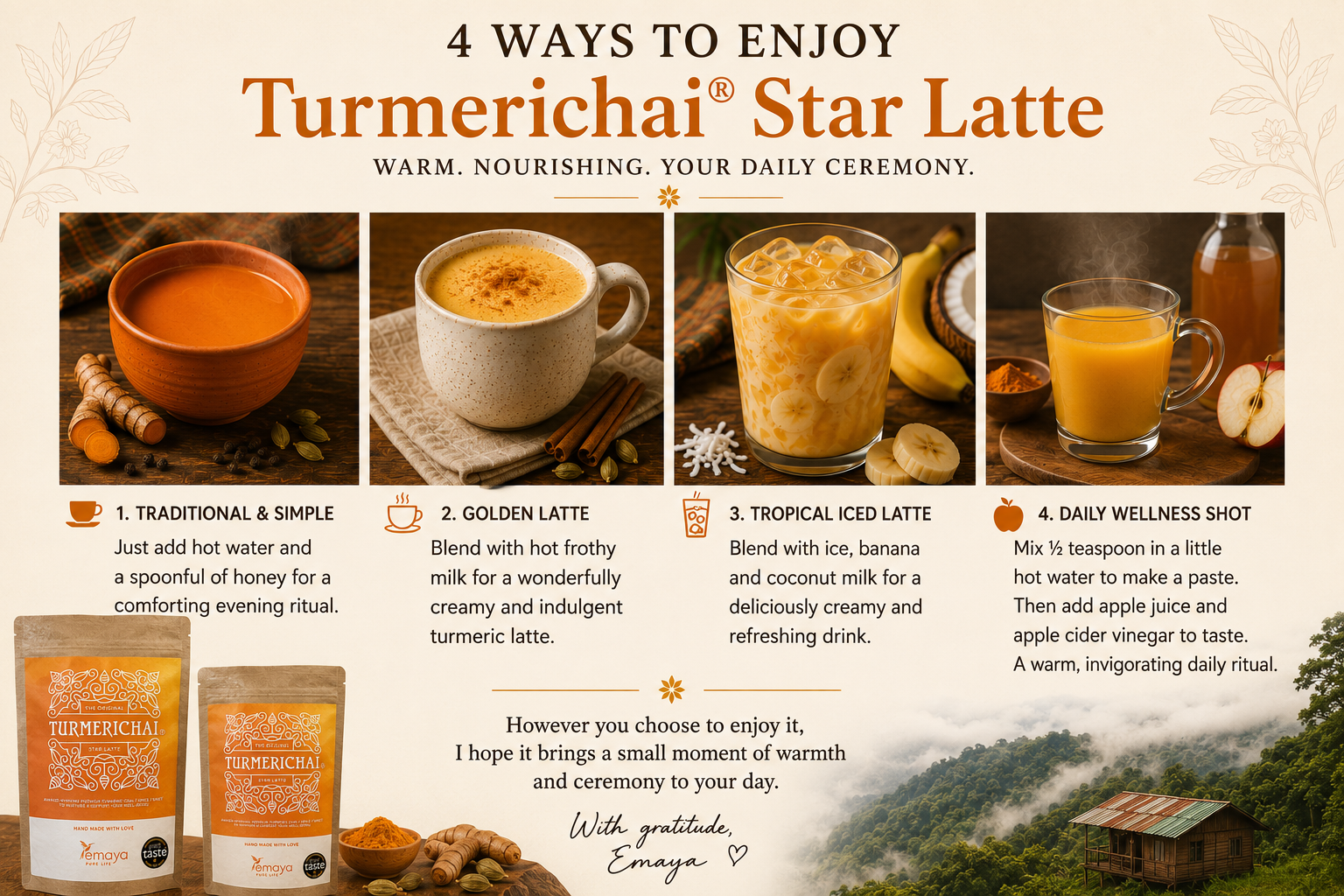
Turmerichai® is not a concentrated curcumin supplement disguised as food.
Nor is it a sweet latte containing a decorative pinch of generic turmeric.
It is an award-winning botanical blend containing 45% whole Lakadong turmeric—crafted to bring natural whole-root potency and genuine enjoyment into the same daily cup.
At £37 for a 150 g pack, Turmerichai® provides 60 servings of 2.5 g. That works out at approximately:
62p per serving
Your turmeric buying checklist
Before buying a shot, capsule, extract, powder or latte blend, check:
Form: Is it fresh juice, dried whole root or an extract?
Measurement: Is the quantity based on fresh weight or dry weight?
Terminology: Does the label mean turmeric, curcumin or total curcuminoids?
Testing: Was curcumin chemically measured or merely estimated?
Processing: What may have been removed during pressing or extraction?
Variety: Is the turmeric cultivar named?
Origin: Is its geographical source traceable?
Potency: Is there a chemical result for the relevant batch?
Inclusion: What percentage of the finished product is real turmeric?
Enjoyment: Will you genuinely want to take it consistently?
If a company cannot answer those questions, the largest number on its packaging may tell you very little.
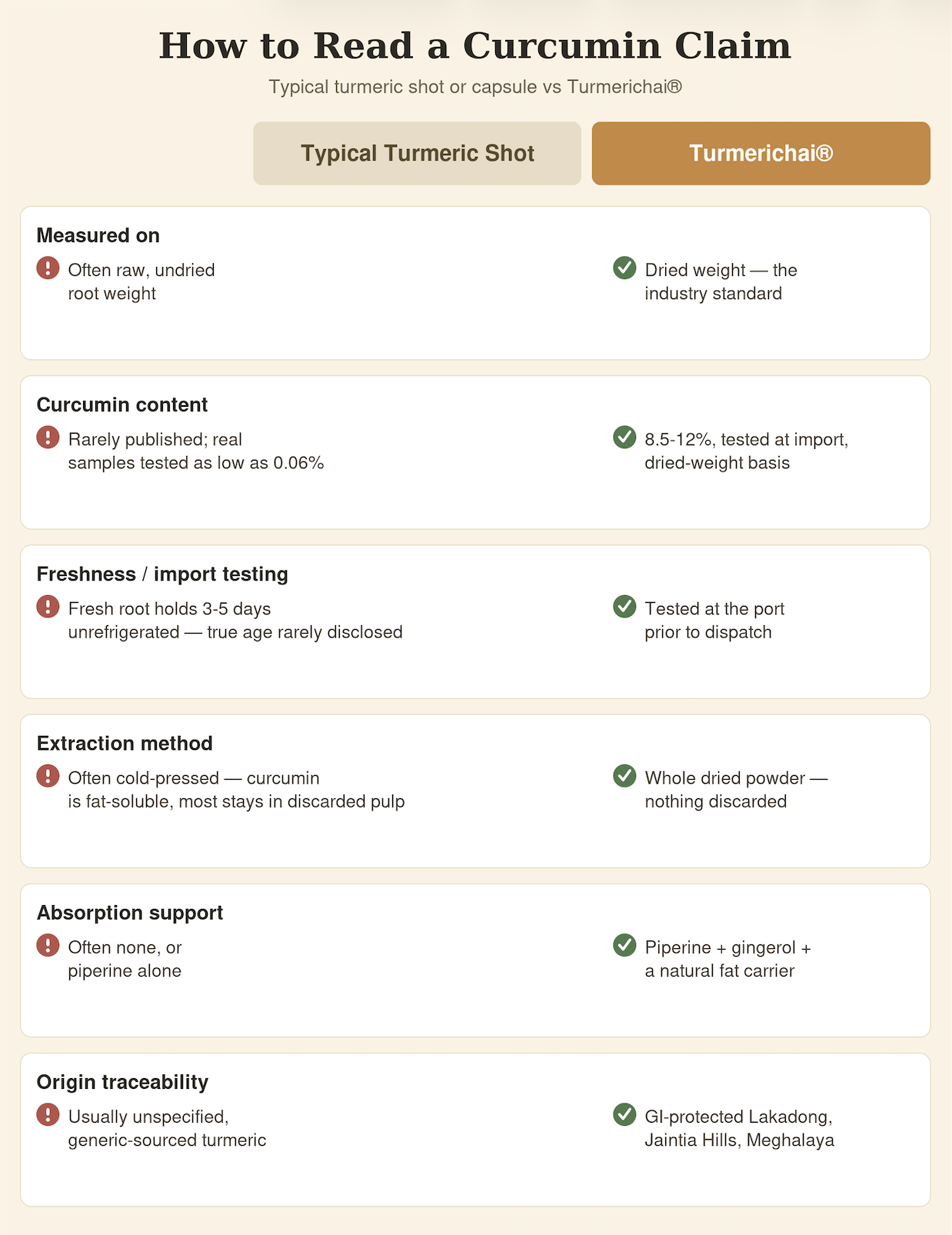
Not all turmeric is created equal.
The bottom line
Buying turmeric can feel like navigating a jungle of incompatible weights, maximum estimates and impressive milligram claims.
You do not need to choose the product with the biggest number. You need to understand what the number represents.
The anonymous 1,750 mg claim combined fresh-root weight with an "up to 5%" figure that had not been chemically established for the batch. On the conventional dry-weight basis, the theoretical maximum would be closer to 350 mg in the whole root before pressing—consistent with independent cultivar-trial data—and potentially 210 mg if the root contained 3%.
Only testing the finished shot could establish what ultimately reached the bottle.
That does not mean every shot is bad or every extract is wrong. It means they cannot be compared with dried whole turmeric by headline numbers alone.
For EMAYA, the balanced choice is clear:
Rare, GI-tagged Lakadong. Direct relationships with its growers. Ingredient-batch curcumin testing. Meaningful whole-root content. Transparent calculations. And a daily ceremony you can genuinely enjoy.
Because taking turmeric should not be a chore. It should be one of the best moments of your day.
[Discover the Turmerichai® range →]
Evidence and methodology note
Turmeric has a long history of culinary and traditional use, including within Ayurveda. Modern research has examined whole turmeric, curcuminoids and concentrated extracts in different preparations and doses. Findings concerning one preparation should not automatically be attributed to another.
The comparisons in this guide concern composition, processing and formulation. They do not establish that equal calculated curcumin quantities from different formats will produce identical effects, nor do they claim that EMAYA products prevent, treat or cure disease.
EMAYA's calculated 96–135 mg range is based on the tested Lakadong turmeric ingredient and disclosed formulation. It is not a finished-product assay.
Selected sources
Jayashree E, Shakkira PK and Anees K (2023). "Turmeric press residue—a high-value by-product of turmeric juice powder." Indian Journal of Horticulture, 80(1), 119–125. DOI: 10.58993/ijh/2023.80.1.18.
Chen M et al. (2023). "Analysis of genetic and chemical variability of five Curcuma species based on DNA barcoding and HPLC fingerprints." Frontiers in Plant Science, 14:1229041.
Kumar KR, Narasimha Rao S and Raja Kumar N (2015). "Evaluation of turmeric (Curcuma longa L.) cultivars at agency areas of north coastal Andhra Pradesh." Progressive Research, 10 (Special-IV), 2417–2420.
Sandeep IS et al. (2021). "Environmental Factors Influencing Yield and Quality of Essential Oils in Curcuma longa cv. Lakadong." Proceedings of the National Academy of Sciences, India Section B: Biological Sciences, 91, 761–767.
Tayyem RF et al. (2006). "Curcumin content of turmeric and curry powders." Nutrition and Cancer, 55(2), 126–131.
UK Advertising Standards Authority (2023). "ASA Ruling on Willy's Ltd": treatment of curcumin-absorption and anti-inflammatory wording as specific health claims.