Turmeric Buying Guide: Shots, Capsules & Curcumin Content -->
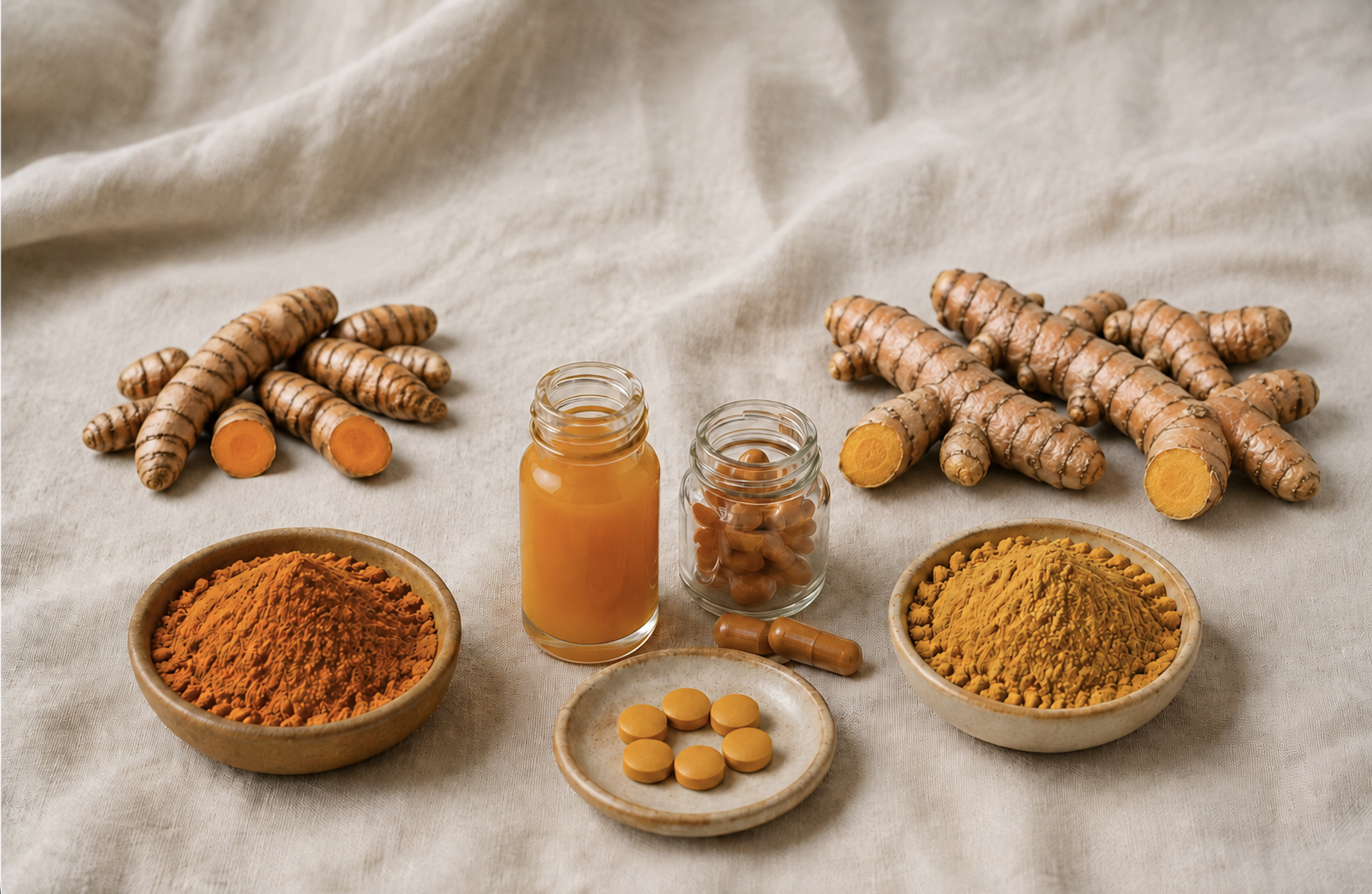
The many faces of turmeric and curcumin
Turmeric Isn't One Thing
I once stood in a health-food aisle holding a turmeric shot, a bottle of capsules and a pouch of turmeric powder—and realised I could not honestly tell you how they compared. Not roughly. Not at all.
The same word appeared on all three labels, but they were three fundamentally different products. One contained pressed fresh root, one contained turmeric or a concentrated extract inside a capsule, and one contained the whole dried root. Nothing on the front allowed me to line them up honestly.
That bothered me enough to investigate properly. What I found is that the word "turmeric" is doing an enormous amount of hiding: hiding the measurement basis, hiding what processing removes and, underneath both, hiding which turmeric plant went into the product at all.
Here is what those labels do—and do not—tell us.
The fresh-weight problem
Fresh turmeric is mostly water. Published research commonly places its moisture content at around 80%, although natural variation is expected. This means 35 g of fresh root may contain only about 7 g of dry turmeric matter.
So when a shot advertises the number of grams of raw root used, that tells us how much fresh material entered production. It does not tell us how much dried turmeric—or how much curcumin—reached the bottle.
This distinction matters because curcumin percentages for turmeric are conventionally reported against dried material. A fresh root described as containing 5% curcumin is based on 5% of the dried root and not of the water content included in the root.
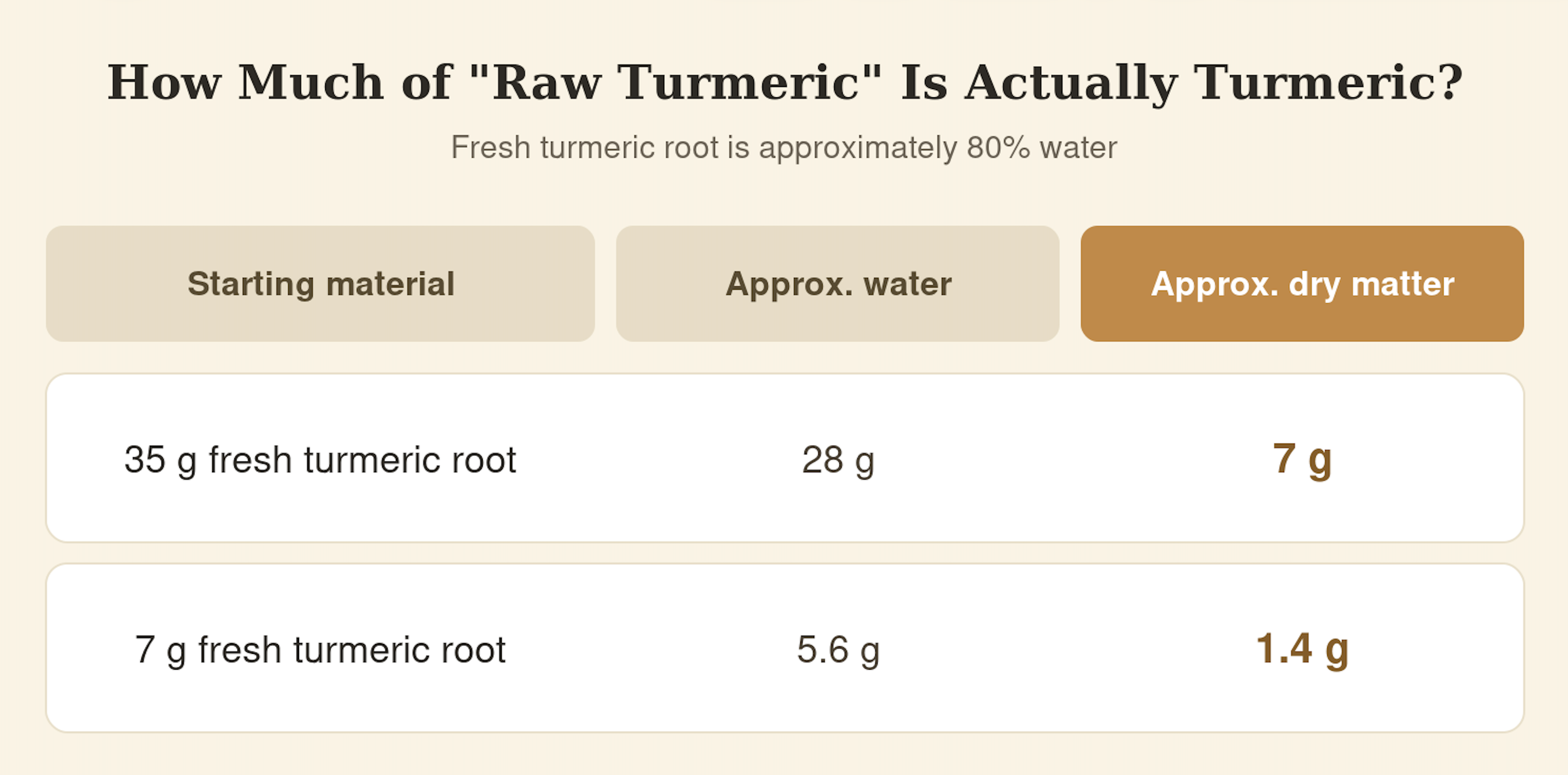
How much of turmeric shots are actually turmeric?
The shot that didn't add up
I reviewed the labels of six turmeric shots currently sold in the UK. I am not naming the brands because this is not about attacking individual businesses. It is about whether the category gives consumers numbers they can compare.
Most did not publish a precise curcumin quantity. Two did. The largest claim was "up to 1,750 mg", based on 35 g of fresh raw turmeric root said to contain up to 5% curcumin.
The calculation was:
35 g × 5% = 1.75 g, or 1,750 mg
But that applies the 5% to the root's entire fresh weight—including approximately 28 g of water.
I contacted the company and asked whether the 1,750 mg had been measured in the finished shot. It confirmed in writing that it had not. The figure was calculated from the potential curcumin content of the raw root before processing.
I then asked whether its assumed 5% was a fresh- or dry-weight figure, whether separated pulp was returned to the drink, and whether a finished batch had ever been independently tested for curcumin. The questions went to its technical team, which later declined to provide further detail on the grounds that the information was commercially sensitive.
Protecting a recipe is reasonable. But explaining the measurement basis behind a prominently advertised number is not the same as revealing a recipe. Nor would publishing a finished-product assay disclose how the shot is made.
Without either, 1,750 mg remains a theoretical pre-processing calculation—not a measurement of what the customer drinks.
What the dry-weight calculation actually gives
If 35 g of fresh root is approximately 80% water, it contains about 7 g of dry matter. Applying the company's assumed maximum of 5% to the dry matter gives:
35 g × 20% dry matter × up to 5% curcumin = 350 mg
That is approximately 350 mg in the entire unpressed root, before anything is removed.
A multi-year agricultural cultivar trial based around Chintapalli offers a useful, if imperfect, real-world check. Within that trial, a turmeric line tested at 5.4% curcumin and yielded 19.5% cured material from its fresh weight; on that measured basis, 35 g of fresh root would contain approximately 369 mg of curcumin before pressing.
Chintapalli is not necessarily the variety used by the shot company. But the result broadly supports the moisture-adjusted calculation: for a root claimed at 5%, around 350 mg before pressing is far more plausible than 1,750 mg unless the company can demonstrate that its particular root genuinely contained 5% curcumin by total fresh weight.
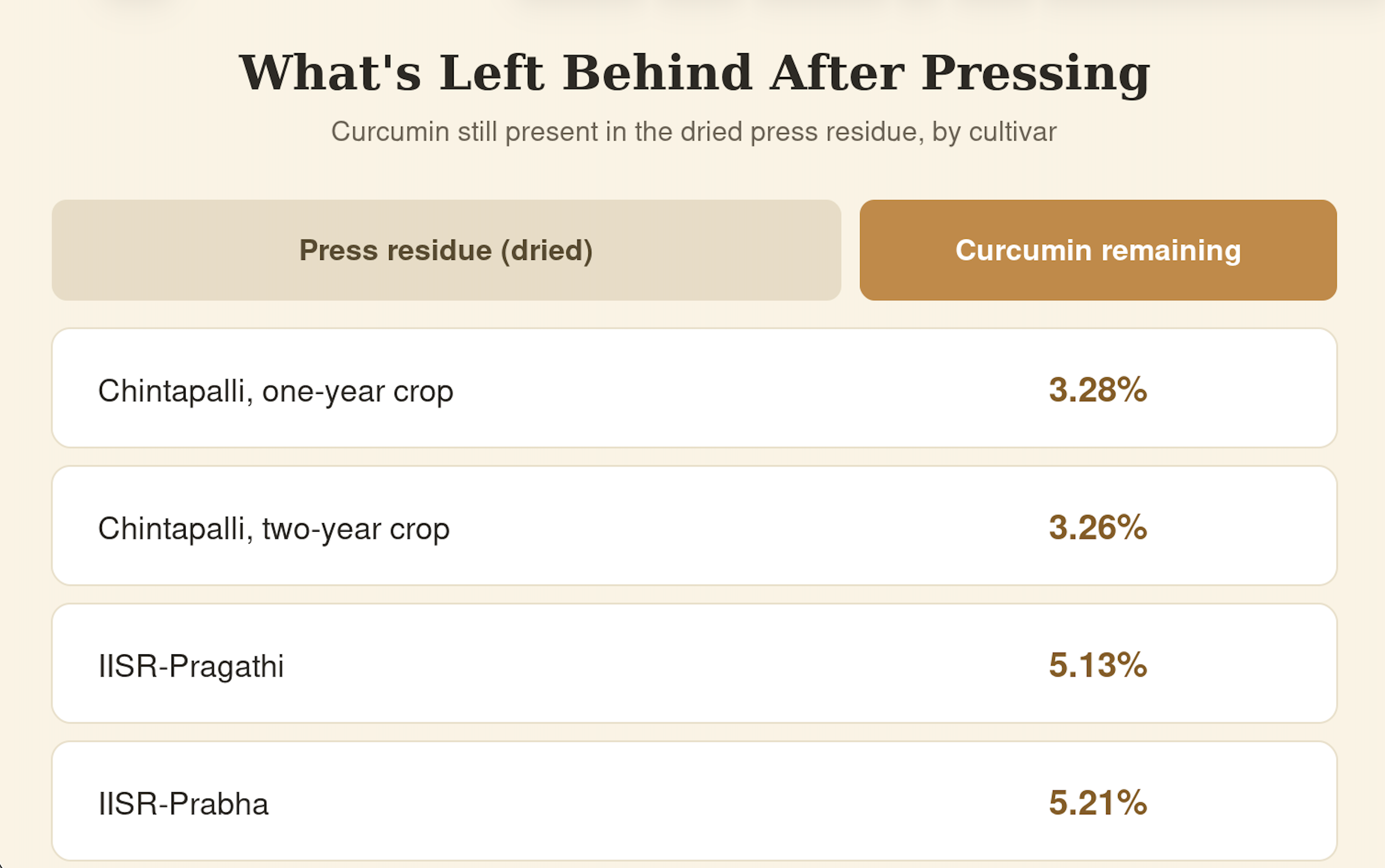
Curcumin residues in the pulp left behind from pressed juice shots.
Then pressing removes almost half the root
A shot is not the whole root. Crushing and pressing divide it into liquid and fibrous residue.
A 2023 study from the ICAR–Indian Institute of Spices Research pressed four turmeric samples: one- and two-year Chintapalli crops, IISR-Pragathi and IISR-Prabha. It recovered approximately 44–53% of the original fresh-root weight as juice.
Applied to 35 g of fresh turmeric, that equates to roughly 15.5–18.6 g of juice. One of the products I reviewed described "up to 18 g turmeric" in its strongest shot—almost exactly what the study's pressing yields would predict from 35 g of fresh root.
The remaining pulp was not empty. Once dried, it still contained:
It also retained oleoresin, essential oils and turmerones. Pressing had not simply transferred the root's valuable constituents into the bottle. A curcumin-rich, oil-rich fraction remained in the solids.
The amount retained appears to vary considerably by cultivar. Comparing the pressing results with published specifications for the same named varieties suggests that a substantial fraction—and in one illustrative calculation, more than half—could remain in the press residue. Because those comparisons draw on separate datasets, they are not direct recovery measurements. But they establish the point that matters: raw-root weight cannot tell us the curcumin content of the finished juice.
Only an assay of the bottled shot can do that.
And most shots were not the 18 g version
The "up to 18 g" product was the strongest shot I reviewed. Many of the others declared around 7 g of fresh turmeric, often without identifying the variety.
At approximately 80% water, 7 g of fresh turmeric contains about 1.4 g of dry matter. If generic commodity turmeric contains 2.5% curcumin, that gives:
7 g × 20% dry matter × 2.5% = 35 mg before pressing
At 2%, it would be approximately 28 mg. Both are theoretical maxima before allowing for anything retained in the pulp.
This does not make fresh turmeric juice "bad". A shot can be fresh, convenient and enjoyable. But grams of water-rich raw root should not be treated as though they were grams of dried whole turmeric—and a pre-processing calculation should not be mistaken for a finished-product measurement.
The capsule that isn't what it seems
Capsules have a different problem. It begins with two terms often used as though they mean the same thing: curcumin and curcuminoids.
Turmeric's principal curcuminoids are curcumin, demethoxycurcumin and bisdemethoxycurcumin. A label saying "95% curcuminoids" does not mean "95% curcumin"; it refers to that family of related compounds.
It is equally important to distinguish whole-root turmeric powder from a standardised extract. A 500 mg capsule of whole turmeric containing 2.5% curcumin provides approximately 12.5 mg curcumin. A 500 mg capsule of concentrated 95% curcuminoid extract is an entirely different preparation.
Traditional turmeric use is grounded primarily in the whole rhizome, while much modern clinical research has examined concentrated extracts. These are different forms of evidence concerning different preparations. Neither should be casually used to make claims about the other.
The layer underneath everything: which turmeric?
Even before processing, turmeric roots are not chemically identical. Variety, terroir, cultivation, harvest, processing and storage can all alter their composition.
Most ordinary turmeric products do not name the cultivar or origin. Lakadong does. It is traditionally cultivated in the Jaintia Hills of Meghalaya and protected by a Geographical Indication. It is renowned for naturally high curcumin, commonly around 7% or more, with tested batches reaching higher.
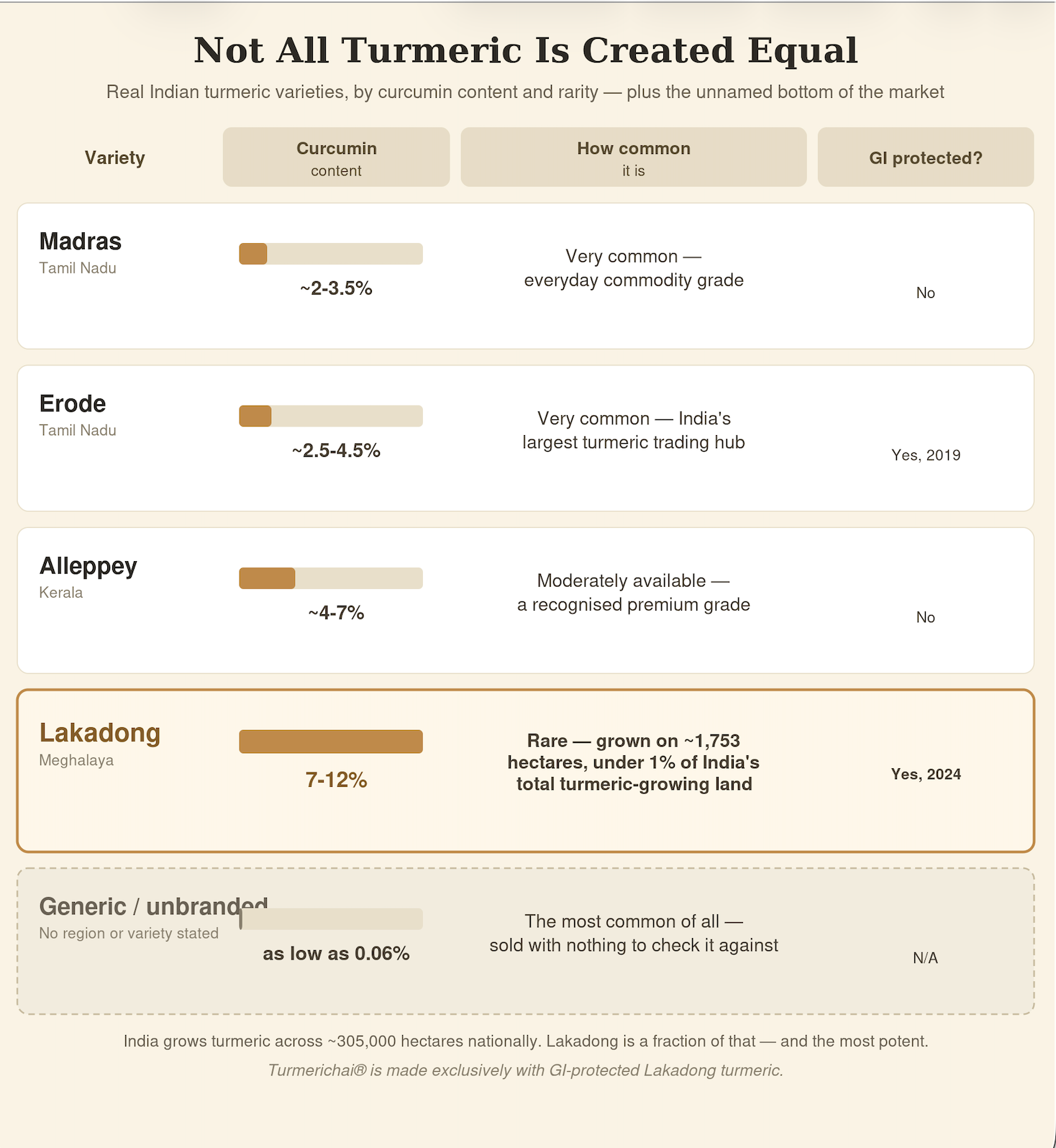
This is where "more curcumin" needs precision. Within comparable whole-root turmeric powders, a genuinely higher tested percentage is a meaningful marker of potency. The same quantity naturally supplies more curcumin while retaining the wider composition of the root.
Our Lakadong batches test between 8.5% and 12% curcumin. On curcumin content alone, one teaspoon of a 10% Lakadong batch contains as much as approximately four teaspoons of whole turmeric at 2.5%, or five teaspoons at 2%.
At the documented extreme, generic turmeric samples have tested as low as 0.06%. A 10% Lakadong batch would be approximately 167 times as concentrated in curcumin. That is an exceptional worst-end comparison—not a description of every inexpensive turmeric—but it illustrates how little the generic word "turmeric" may reveal.
Lakadong is more than curcumin
Reducing Lakadong to a single compound would repeat the mistake made by much of the turmeric category.
Its aromatic oil contains turmerones, including ar-turmerone, α-turmerone and curlone. A study of Lakadong grown across five agroclimatic regions found that ar-turmerone represented approximately 36–44% of its rhizome essential oil, although oil yield and composition varied with growing conditions.
These compounds are not represented by a curcumin number. They are part of the reason we favour a naturally high-curcumin whole root, rather than treating isolated curcumin as though it were the entire plant.
This distinction is especially relevant in the turmeric-latte market. Turmerichai® contains 45% whole Lakadong turmeric. Turmeric-latte powders generally vary a great deal in how much actual turmeric they contain relative to milk powders, sweeteners and flavourings — we haven't measured other brands' inclusion rates ourselves, so we won't put a number on the gap, but the proportion of real turmeric in the blend is worth checking on any latte powder, including ours. We have not separately quantified turmerones in the finished blend, so this is a compositional distinction rather than a finished-product turmerone claim—but the amount and quality of whole turmeric used still matter enormously.
What you can calculate from Turmerichai®
A 2.5 g serving of our 45% Turmerichai® formula contains 1.125 g of whole Lakadong turmeric:
2.5 g × 45% = 1.125 g Lakadong turmeric
Based on the independently tested 8.5–12% curcumin content of the Lakadong ingredient used in our blends, that serving is calculated to provide:
Approximately 96–135 mg of naturally occurring curcumin
That word—calculated—matters. We test the Lakadong turmeric ingredient before blending. We have not separately assayed the finished Turmerichai® blend for curcumin, so 96–135 mg is a transparent formulation-based calculation, not a claim that every serving has been laboratory-confirmed at an exact level.
The calculation is reproducible because the essential information is disclosed:
a defined 2.5 g serving;
a known 45% whole-Lakadong inclusion rate;
a tested turmeric ingredient containing 8.5–12% curcumin; and
a dry whole-root basis, with no curcumin-rich pulp discarded.
For context, 96–135 mg is equivalent on calculated curcumin content to roughly eight to eleven 500 mg whole-turmeric capsules at 2.5%. It is also approximately three to four times the theoretical pre-press amount in a common 7 g fresh-turmeric shot made with 2.5% turmeric.
These are compositional comparisons, not promises that different preparations will have identical effects in the body. Form, food matrix, individual digestion and preparation all matter.
What EMAYA does differently
This is the problem EMAYA exists to solve. We are not interested in being another turmeric brand with another impressive-looking number. Someone choosing turmeric deserves to know what is actually in the product—and how the figure was reached.
For Turmerichai®, we choose GI-protected Lakadong because it offers the balance we want: exceptionally high natural curcumin together with its turmerone-rich aromatic oil, within the whole root. We do not isolate the curcumin or discard the rest of the rhizome.
I travel to Meghalaya and work directly with growers in the Jaintia Hills. The Lakadong ingredient is tested before blending, and the calculation behind our serving is available for anyone to check. We combine it with warming spices and coconut milk powder in a botanical ceremony designed to be enjoyed—not swallowed as another handful of capsules or endured as an intense shot.
At the current price of £37 for a 150 g pack, there are 60 × 2.5 g servings. That works out at approximately 62p per serving before any offer or bundle saving.
The question every turmeric label should answer
The question is not simply, "How many milligrams are printed on the front?"
It is:
What form of turmeric is this, which root did it come from, how was the number calculated—and can I check it?
With EMAYA, the answer is visible: named and traceable whole Lakadong turmeric, a tested ingredient batch, a disclosed inclusion rate and an honest calculation based on dry whole root.
That is the difference between trusting a label and being able to check it.
Not the biggest number. A meaningful one you can actually understand—and a daily botanical ceremony you can genuinely enjoy.
[Discover the Turmerichai® range →]
Evidence and methodology note
Turmeric has a long history of culinary and traditional use, including within Ayurveda. Modern research has examined whole turmeric, curcuminoids and concentrated extracts in different preparations and doses. Findings from one form should not automatically be attributed to another.
The comparisons in this article describe composition, processing and formulation. They do not establish that equal calculated curcumin quantities from different products will produce identical physiological effects, and they do not claim that EMAYA products prevent, treat or cure disease.
Selected sources
Jayashree E, Shakkira PK and Anees K (2023). "Turmeric press residue—a high-value by-product of turmeric juice powder." Indian Journal of Horticulture, 80(1), 119–125. DOI: 10.58993/ijh/2023.80.1.18.
Kumar KR, Narasimha Rao S and Raja Kumar N (2015). "Evaluation of turmeric (Curcuma longa L.) cultivars at agency areas of north coastal Andhra Pradesh." Progressive Research, 10 (Special-IV), 2417–2420.
ICAR–Indian Institute of Spices Research. Official varietal specifications for IISR-Pragathi and IISR-Prabha.
Sandeep IS et al. (2021). "Environmental Factors Influencing Yield and Quality of Essential Oils in Curcuma longacv. Lakadong." Proceedings of the National Academy of Sciences, India Section B: Biological Sciences, 91, 761–767.
Government of India / Invest India. North East Food Processing Brochure: Lakadong turmeric and its naturally high curcumin content.
Tayyem RF et al. (2006). "Curcumin content of turmeric and curry powders." Nutrition and Cancer, 55(2), 126–131.
UK Advertising Standards Authority. Willy's Ltd ruling (2023): treatment of curcumin-absorption statements as specific health claims.